
What process improvement consulting actually delivers
A process improvement engagement produces four things: a documented map of how the process runs today, a small set of measurements that describe its performance, a redesigned process with named owners, and the control mechanism that keeps the new design from decaying. If an engagement produces slides but none of those four artefacts, nothing has been improved.
Established companies rarely suffer from a shortage of improvement ideas. They suffer from undocumented processes, contested measurements and improvements that quietly revert within two quarters because no one owned the new standard. The method below is designed around those three failure modes.
Which processes are worth improving
Most companies have between ten and twenty processes that determine whether the business delivers: quote-to-order, order-to-cash, procurement, hiring and onboarding, month-end close, new product introduction, incident handling, customer onboarding. Everything else is peripheral. Improvement work should start with the processes that carry the most volume, the most cost, or the most customer-visible failure.
A quick prioritisation test: how often does the process run, what does one failure cost, and how many functions does it cross? High frequency plus high failure cost plus cross-functional handoffs is where the recoverable value sits. A monthly process owned end-to-end by one team is usually not the place to start.
The five-phase sequence
1. Map the process as it is run
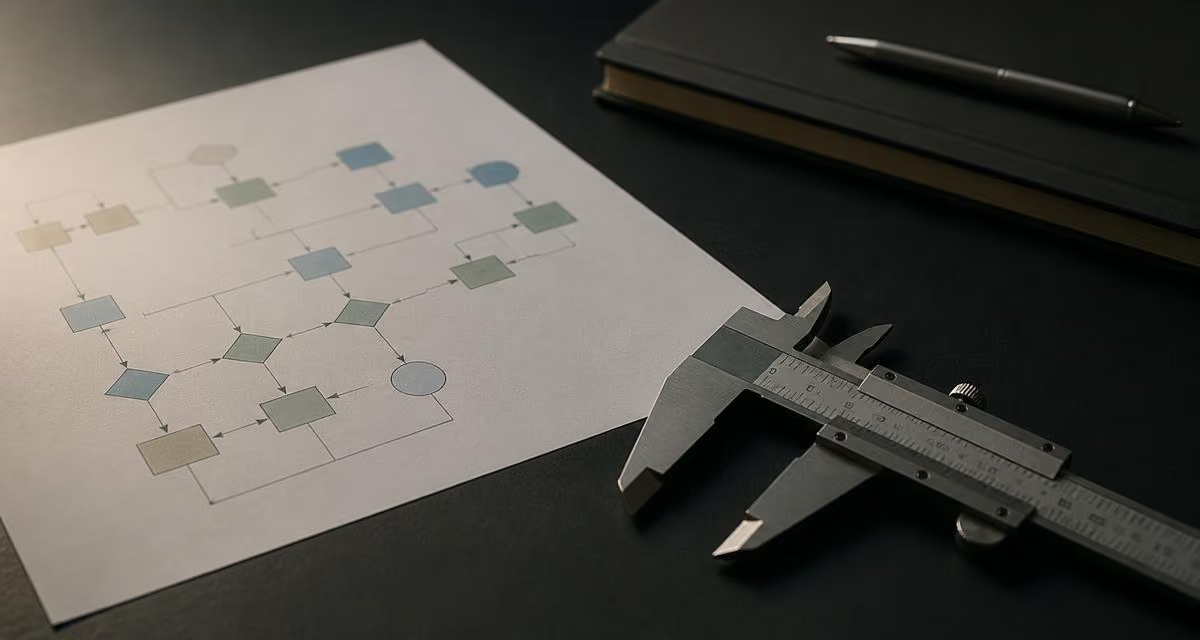
Not as the manual describes it and not as the leadership team believes it works. Sit with the people who run it, walk the actual steps, and record every handoff, approval, rework loop and workaround. Expect to find two or three undocumented steps that exist only because a system or a policy failed years ago.
The output is a single-page flow with each step, its owner, its input, its output, and the system it touches. One page forces the clarity that a forty-box diagram avoids.
2. Measure it honestly
Four measures cover most processes: cycle time end to end, touch time (the work actually performed), first-pass yield (the share completed without rework), and cost per transaction. Take a real sample over a real period. Averages hide the problem; look at the distribution and the worst decile, because that is where customers and cost live.
Measurement is where engagements stall, because the data is usually incomplete. Take a deliberately small, defensible sample rather than waiting for perfect instrumentation. The definitions you write here become part of the operating KPI system.
3. Find the constraint, not the irritations
Every process has one binding constraint and a long list of annoyances. Improvement effort applied anywhere except the constraint produces no throughput gain. Look for the step where work queues, where approvals wait, or where rework originates. Waiting time — not working time — is usually the majority of cycle time.
4. Redesign with the people who run it
Redesign in the room with the operators, not in a separate workstream. Remove steps before automating them, collapse approvals to the smallest number that manages real risk, and make the handoffs explicit. The test of a good redesign is that the people who will run it can describe it without reading it.
Where the redesign crosses functional boundaries or changes who decides what, it is an operating model question, not a process question — see the target operating model guide.
5. Hold the gain
The improvement is real only when it survives without attention. That requires a written standard operating procedure, a named process owner, one or two measures reviewed on a fixed rhythm, and a defined trigger for revisiting the design. Without the rhythm, the process reverts. The review slot belongs in the operating cadence.
Why process improvement programmes fail
- Automating the current mess. A workflow tool applied to an unexamined process makes the waste faster and harder to see.
- Improving everything at once. Parallel improvement across eight processes exhausts the same handful of capable people.
- No named owner. A process owned by a committee reverts to whatever each function finds convenient.
- Measuring after the fact only. Monthly retrospective reporting cannot correct a process that fails weekly.
- Improvement as a programme. Campaigns end. Cadence-based review does not, which is why it holds.
What a typical engagement looks like
A single-process engagement runs six to ten weeks: two weeks to map and measure, two to three weeks to redesign with the team, and the remainder to pilot, document and hand over to the internal owner. A multi-process engagement is sequenced, not parallelised — one process reaches handover before the next begins.
We work alongside the people who run the process rather than above them, and the objective is always the same: leave a documented, owned, measured process that the company runs itself. Where several processes are weak at once, the underlying issue is usually systemic and belongs in the operational excellence track.
Related guides
Operational Excellence
The five systems and execution habits that turn strategy into predictable operating outcomes.
Read guide →
Operating KPI System
The fifteen numbers on a single page, refreshed weekly, that a leadership team acts on.
Read guide →
Operating Cadence
The four meetings that run an executive team, and the rules that keep them from collapsing.
Read guide →
Frequently asked
Questions this guide answers
- What does a process improvement consultant actually do?
- A process improvement consultant maps how work is currently performed, measures its cycle time, rework and cost, redesigns the process with the team that runs it, and installs the documentation, ownership and review controls that keep the improvement in place after the engagement ends.
- How long does a process improvement project take?
- A single core process typically takes six to twelve weeks: two to three weeks to map and measure, three to four weeks to redesign and pilot, and the remainder to document, train and hand over ownership.
- How is process improvement measured?
- Against a baseline captured before any change: cycle time, throughput, rework or error rate, cost per transaction, and the share of cases that follow the documented path. Improvement claims without a pre-change baseline are not credible.
- Do you need Lean or Six Sigma certification to improve processes?
- No. Certification codifies useful tools, but process improvement in an established company depends on accurate mapping, honest measurement, redesign with the process owners, and controls that hold the change.